
Showing posts with label Pope Benedict XVI. Show all posts
Showing posts with label Pope Benedict XVI. Show all posts
Wednesday, January 28, 2015


Friday, January 23, 2015

Saturday, November 22, 2014

Monday, November 10, 2014
When Benedict XVI Breaks His Silence and Corrects His Successor
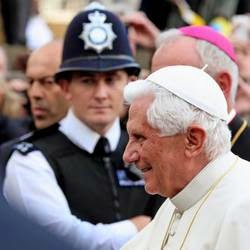 |
| Pope Benedict XVI in Great Britain 2010 |
(Rome) Since the end of February 2013 Benedict XVI who is in the unprecedented situation of an emeritus pope, has engaged more and more often in recent times in taking up his feather to send public messages. These messages appear as corrections to mistakes, without mentioning the originator by name. The corrections relate to the dialogue with atheists, criticism of Cardinal Kasper and praise for his opponent Cardinal Burke, publicly expressed joy over the traditional rite over which Pope Francis has kept silent till now, in clear criticism of his successor. Benedict XVI. sent four messages in the month of October alone. A brief synopsis.
Greetings to the Proscribed "Ecumenism of Return"
The most recent example is a greeting message on the fifth anniversary of the Apostolic Constitution Anglicanorum Coetibus, with the establishment of Personal Ordinariates for former Anglicans who have returned in full unity to the Catholic Church. Benedict XVI.'s message came to the Ordinary of the oldest of these Personal Ordinariates, that for England and Wales Our Lady of Walsingham. With this the emeritus pope sent four messages in the month of October alone.
Benedict XVI. has broken his silence more frequently of late. For example, to say that in the Church that each renunciation of the truth is "fatal" for the promulgation of the Christian faith. Strong, clear words in a rich dialectical angle appropriate to these times that more or less engage in nice talk and allow everything. The emeritus pope is especially saying that the program so proclaimed by his successor Pope Francis in Gaudium Evangelii, namely, that it does not convey the joy of the Gospel.
Francis' Praise for Benedict: "Discrete" - But his predecessor is not so silent
"He is discreet, modest, does not want to interfere," said Pope Francis recently about his predecessor, Benedict XVI. The occasion was the blessing of a bust, which has been dedicated to the German Pope. "I can feel it, as if I had a grandfather in the house, because of his wisdom. It does me good to hear him. And he encourages me very much," said the reigning Pope with perhaps a not wholly accurate comparison, especially since Francis will be 78 years old in a few weeks and so belongs to the same "grandfather generation" as Benedict XVI..
Occasionally, this much is known, Benedict XVI. is in the role of a "cloistered monk" as he himself says, advises, comments and contacts the reigning Pope with his view of things. Not much is known about it, but it is all done with the utmost discretion. But it was announced that Benedict XVI. sent his Argentine successor a four-page commentary on the controversial interview in the Jesuit journal La Civiltà Cattolica which appeared on 19 September 2013.
The content of the comment is not known. However, one can imagine the polite and respectful tone of the dense criticism. The words can not have been missed for lack of clarity. What is between the two popes, brings us ever to absurdity, are exchanged subject to a strict confidentiality.
Francis - Benedict: Different "Dialogue" with Atheists
Sometimes Benedict XVI breaks. his monastic seclusion and is visible. From his message to the Coetus Internationalis Summorum Pontificum on the occasion of the Third International pilgrimage to Rome of Tradition, he explains that he does so only at the request and invitation of the reigning Pope. The most recent example was his participation on 19 October at the beatification of Pope Paul VI. There has been no word if Benedict was moved by these performances.
He breaks silence but occasionally in written form, has his say and does so with the clarity of language and thought that is usual for him. It never involves mere polite words or meaningless collections of words, as the written messages of some ecclesiastical dignitaries seem to be.
The first of these public written statements of Benedict took place last fall coinciding with the "dialogue" of Pope Francis with the atheists Eugenio Scalfari, Benedict XVI replied to another atheist, Piergiorgio Odifreddi (see . Benedict XVI Responds to Atheists Piergiorgio Odifreddi: "Your Religion Mathematics Remains Empty" ). While Francis' interview with Scalfari is controversial in form and content, and as it later turned out, Scalfari had formulated their responses with the pope's approval, Benedict significantly answered atheism. Scalfari could triumphantly concur at the end of the conversation that because the Church supposedly renounced Her mission to convert others to Christ and lifted the subjective conscience to the highest standard, while Benedict XVI. showed his "interlocutor" Odifreddi that the "religion of mathematics remains empty" and defended the Catholic Church and the priesthood against the "sport" of the irreligious, who furthermore, try to put the clerical state generally under the shadow of child abuse and homosexuality.
Note to Overcome the Crisis in the Church Ignored Magisterium
Benedict XVI. also broke his silence last March in connection with a book about Pope John Paul II. The former Prefect of the CDF prefect particularly emphasized the encyclical Veritatis Splendor from the year 1993 on moral issues and the declaration Dominus Iesus in 2000 "on the unicity and universality of redemption by Jesus Christ and the Church" and recommended not only their thorough study, but to learn the content. Benedict XVI. then named key documents of the recent Papal Magisterium, pointing to the two most ignored and disregarded **documents** within the Church. Benedict's note thereby designates a barometer for the state of the Church and provides instruments, that can provide the remedy.
So Benedict is not confined to prayer and sacrifice. He responds not only to atheists, but also offered advice to the Church.
In October, the same four messages followed, three short but dense messages and a longer message.
Message to Strengthen Tradition: Traditional Rite not "Fashion"
The first bears the date of October 10 and was sent to the above mentioned Coetus Internationalis Summorum Pontificum, which organized the pilgrimage of tradition to Rome founded in 2012, with the aim to show the solidarity of traditional Catholics with the Pope and celebrate the traditional Rite in St. Peter's Basilica at the most visible church in Christendom at the tomb of the Prince of the Apostles, Peter and the tombs of the popes. High-ranking cardinals participated. This year Cardinal Raymond Burke participated who has become, in the course of the Synod of Bishops on the Family, a spokesman for the defense of the marriage sacrament and the Catholic teaching on marriage. In addition, Cardinal Burke Cardinals George Pell [Who was ill] and Walter Brandmüller were present, who are also among the cardinals who publicly opposed the "New Mercy" of Cardinal Walter Kasper obviously supported by Pope Francis.
Pope Benedict XVI. stressed the importance of the traditional rite in his message. A more meaningful gesture so, especially since Pope Francis has so far not publicly expressed anything contradictory or unofficially, but in the majority, however, has sent negative signals. Quite different from his predecessor: "I am very happy that the usus antiquus now lives in full peace in the Church, even among the young, with support and the celebration by great cardinals." A single sentence with a huge message. Benedict XVI.'s observers especially noticed the choice of words. The emeritus pope has no longer speaks using his Motu Proprio Summorum Pontificum definition where the Old Rite is called the "extraordinary form" of the Roman Rite, but speaks of "usus antiquus". He so used that definition, not as it is represented tradition and enhanced the traditional rite so well with Motu proprio, rather, he actually raised it to its rightful position. Benedict XVI. is too wise a man not to weigh the importance of words exactly.
This includes the statement that he is "happy" about the fact that the youth are finding the traditional Rite. A clear response to his successor, without mentioning this of course, who commented at the ad limina visit of the Czech Bishops in February, not being able to understand how young people love and appreciate the old Rite could and in this context of spoke of mere "fashion", therefore, which should not "do not pay so much attention." During his stay in Brazil for World Youth Day, the Pope referred to traditional Catholics as Pelagian ideologues. What the Church leader said exactly, remains unclear. The two statements, taken together, seem to have recognized a "ideological" reservation against the traditional Rite by the Pope.
Praise for Cardinal Burke and the Opponents of Cardinal Kasper
Another important statement can be found in Benedict's short message, that when he was "happy" estimates that the "usus antiquus" is supported and celebrated by "great cardinals". Words that can be construed as a fairly unambiguous partisanship against Cardinal Kasper and the "opening arguments". Above all, it is an expression of the highest appreciation for Cardinal Burke, one of those church leaders, whom Pope Francis will not only deny any role in the Roman Curia, but also the leadership of a diocese.
While Pope Francis would dearly love to shoot the American Cardinal to the moon, but is not too sloppily inaccurate that at least he would like to banish him to a lonely monastery on a remote island, Benedict XVI. honored him as a "great" cardinal (see Malta exiles? Final Papal Purge of Cardinal Burke? ).
"Any Waivering from the Truth is Fatal" for the Mission, Faith and Church
The second message was sent by Benedict XVI. at the Pontifical Urban University in Rome, which named the ballroom after the emeritus pope. The ceremony for the naming took place on 21 October, but Benedict XVI. did not take part in it. He gave the reason in the greeting message of 19 October. In his place, he sent Curia Archbishop Georg Gänswein, his personal secretary to offer greetings.
Amazingly, the University did not publish the message on its website. Neither did the Osservatore Romano , which only made a brief note of the event. Thus it was held under lock and the text was finally made public only on 23 October, with the approval of Benedict and thanks to the Vaticanist Armin Schwibach.
The Pontifical University, the University Mission of the Catholic Church par excellence, since it is under the Roman Congregation for the Evangelization of Peoples, which is also known as Propaganda Fide.
Here Benedict XVI expressed the central message, that any waiver from the truth of the Christian mission, faith and Church is "fatal". The German Pope spoke of the doubt, which threatens the principle of the mission ad gentes today. The emeritus pope contradicts the convenient thesis, that one could replace mission through a "dialogue of equals" between religions and this convenience to abandon mission and conversion, justified by the "common commitment to peace". To put it crudely: Most important is that the people do not beat their heads against the wall, everything else is secondary.
With such an attitude, however, the Church would move away from what the first Christians did, is to proclaim the Gospel of Jesus Christ to the ends of the earth. Benedict XVI. disagreed especially with the equality of religions, which are just different expressions for something, that God had, ultimately for people ,is not really detectable in any case and that the religions simply represent just attempts of detecting and thus are only variations of the same reality. "This renunciation of the truth seems realistic and useful for the peace among the religions of the world. And yet it is fatal to the faith. Because the faith loses its binding character and its seriousness, if everything is reduced to ultimately interchangeable icons that are able only to point distantly to a point of access for the inaccessible mystery of godliness. "
Once again Dominus Iesus and again Cardinal Walter Kasper
Also in this opinion swings unspoken declaration of Dominus Iesus which provoked fierce criticism outside but also within the Church in the Holy Year 2000, because it stood in the way of the attitude of capitulation, as it was called by the late legal philosopher Mario Palmaro, in parts of the Church and it was perceived by these accordingly as annoying and cumbersome, who want to embrace all religions and ideologies, because they want to throw away their own job and no longer believe in the final analysis of their own faith. This form of the apostasy in the Church is not a new phenomenon, but occurs today more than ever, without being previously addressed within the Church.
Among the fiercest critics of Dominus Iesus were included Cardinal Edward Cassidy, then chairman of the Pontifical Council for Promoting Christian Unity and his successor in that office, Cardinal Walter Kasper, who again is unastonishingly part of the circle again. Even more amazing and worrying is that Cardinal Kasper under Pope Francis became the papal house theologian, relied on by the reigning Pope and aligns himself to his theology that he ebulliently praised as "theology on his knees" last February 21 in the cardinal consistory ,
Clear Order of Mission Against "Waivering From Mission"
Above all, Benedict XVI replied. in concise and clear language to the confusing designs of Pope Francis with a no to proselytism and a mission without conversion (see No to conversions, Yes to Mission - the Pope Contradicts Himself? as If "dialogue process" is confused with "missionary going out" ) , Statements, which he made, inter alia, in the dubious first interview of atheist Scalfari. As mentioned, the answers come from Scalfari's pen, but he sent them to the Pope before going to press and received the imprimatur from his secretary. Answers that were never denied by the Holy See, and can hardly be doubted in their authenticity of content, especially since the Pope has repeated them in other contexts.
In the end, Benedict XVI. makes the title of the Apostolic Exhortation by Pope Francis, Gospel gaudium, his own, albeit in a somewhat modified form of content. Whoever has received the "joy" of faith, could not do otherwise, as they pass through life. The Emeritus grasped this "going out", which is so important to the reigning pope, in its slightly different context, namely that it is without an actual or apparent renunciation of the truth, which could be "fatal ".
Benedict affirms "Non-Negotiable Values" Against Incomprehension of His Successor
The third message even bears the date of August 4, but was released on 23 October. It is a letter Benedict sent to the the Vatican Foundation Joseph Ratzinger -Benedikt XVI. ,attending a meeting organized by them in Medellin in Colombia, called "Respect for Life, a Way for Peace".
In this letter, Benedict XVI underlined the "unconditional respect of the created in the image of God and thus equipped with an absolute dignity of human life". For this reason, said Benedict, "the theme of peace and the issue of respect for a human life of faith in God the Creator are bound to be the true guarantee of our dignity."
Benedict XVI. affirmed without any ifs and buts, a renewed commitment to the non-negotiable values, which his successor Francis has "never understood" in his own words and about which he has remained silent for long months of his pontificate and does it in the public at large effectively to this very day (see A Non-Negotiable Pope - Francis Smashed Another Key Element of Benedict XVI. ).
Personal Ordinariate Serves an Important Task
The fourth message, also dated 10 October, but only now published, was written by Benedict XVI. in German. Seat of the ordinary of the Personal Ordinariate of Our Lady of Walsingham is the "Bavarian chapel" in London, which then reminds us of the former Duchy's diplomatic representation of the Kingdom of Bavaria in England. A symbolic connection between the Ordinariate and the Bavarian Pope.
Benedict XVI. writes that the Personal Ordinariates serve an "important job in the whole of the Church of God".
Friday, November 7, 2014
Catholic Civil War Has Begun
‘At this very critical moment, there is a strong sense that the church is like a ship without a rudder,’ said a prominent Catholic conservative last week. No big deal, you might think. Opponents of Pope Francis have been casting doubt on his leadership abilities for months — and especially since October’s Vatican Synod on the Family, at which liberal cardinals pre-emptively announced a softening of the church’s line on homosexuality and second marriages, only to have their proposals torn up by their colleagues.
But it is a big deal. The ‘rudderless’ comment came not from a mischievous traditionalist blogger but from Cardinal Raymond Burke, prefect of the Apostolic Signatura — that is, president of the Vatican’s supreme court. As it happens, Pope Francis intends to sack Burke, whose habit of dressing up like a Christmas tree at Latin Masses infuriates him. But he hasn’t got round to it yet. And thus we have the most senior American cardinal in Rome publicly questioning the stewardship of the Holy Father — possibly with the tacit approval of Pope Emeritus Benedict XVI.
Nothing like this has happened since the backstabbing behind the scenes at the Second Vatican Council 50 years ago. It raises the question: is the Catholic church in the early stages of a civil war between liberals and conservatives, fought not over liturgical niceties (the source of relatively harmless squabbles under John Paul II and Benedict XVI) but fundamental issues of sexual morality?
The October synod was a disaster for Pope Francis. Before it started, he had successfully tweaked the Catholic mood music relating to divorcees and gay people. The line ‘Who am I to judge?’, delivered with an affable shrug on the papal plane, generated friendly headlines without committing the church to doctrinal change. Conservatives were alarmed but had to acknowledge Francis’s cunning. ‘Remember that he’s a Jesuit,’ they said.
Then Francis did something not very cunning. Opening the synod, which would normally be a fairly routine affair, he encouraged cardinals and bishops to ‘speak boldly’. Which they did, but not in the way he intended.
The Pope’s first mistake was to invite Cardinal Walter Kasper, the Vatican’s 81-year-old retired head of ecumenism, to set the agenda for the synod by addressing the world’s cardinals back in February. Kasper told them that the church should consider giving Holy Communion to remarried Catholics.
Even if Francis supports this notion — and nobody knows — his choice of Kasper was a blunder because the cardinal, in addition to being a genial and distinguished scholar, is leader of a German-led faction that represents, in Catholic terms, the far left of the theological spectrum. In 1993 Kasper, then Bishop of Rottenburg-Stuttgart, co-signed a letter by German bishops demanding that Catholics living ‘in a canonically invalid union’ should be allowed to decide for themselves whether to receive the Eucharist. The German church is a law unto itself: although its services are empty, it is rich, thanks to the country’s church tax, and arrogant. To cut a long story short, this faction — which had ruthlessly undermined Benedict XVI’s authority when he was pope – tried to hijack the synod.
They messed it up. The synod’s ‘special secretary’, the Italian archbishop Bruno Forte, wrote a mid-synod report suggesting that the participants wanted to recognise the virtuous aspects of gay unions. In doing so, Forte — an even more radical figure — overplayed his hand. Most synod fathers wanted no such thing. Cardinal Gerhard Müller, prefect of the Congregation for the Doctrine of the Faith, and Cardinal George Pell, head of the Vatican’s finances, were horrified. They ensured that the final report kicked Communion for divorcees into the long grass and did not even mention homosexual relationships. ‘Synod rebuffs Francis on gays,’ reported the media — the last thing the Pope wanted to read.
To make matters worse, Kasper gave an interview in which he said that anti-gay African Catholics ‘should not tell us too much what we have to do’. (click here for Kasper the Friendly Liar). At which point Cardinal Burke called him a racist. Kasper reacted furiously and is telling anyone who will listen that the church will soon drastically change its rules on access to Communion. This is wishful thinking.
And now another voice is being heard. The last pope is neither dead nor senile nor as silent as we thought he was going to be. In the last month Benedict XVI has written to the ex-Anglicans of the Ordinariate expressing delight that they now worship in the former Bavarian chapel in Warwick Street, London; to Rome’s Pontifical Urban University about the dangers of relativism; and, most significantly, to supporters of the old liturgy. ‘I am very glad that theusus antiquior [the traditional Latin Mass] now lives in full peace within the church, also among the young, supported and celebrated by great cardinals,’ he said. In fact, very few cardinals celebrate in the old rite. But one who does is Raymond Burke. ‘Benedict is well aware of that,’ says a Ratzinger loyalist. ‘He’s not under the illusion that he’s still pope, but he was appalled by the sight of Kasper trashing his legacy and he is making his displeasure clear.’
Where does this leave Francis? Looking a bit like ‘the Hamlet Pope’, Paul VI, whom he has beatified. He supports some sort of reform, but uncertainty is breaking the church into factions reminiscent of the Anglican Communion. Old enemies of Benedict XVI reckon they can persuade Francis to stack the college of cardinals in their favour. Meanwhile, Burke has emerged as leader of the hardline traditionalists. ‘He did not want this role but perhaps he sees himself as a St John Fisher figure,’ says one Vatican source, a comparison that casts the successor of Peter in the role of Henry VIII.
What should worry Francis is that moderate conservative Catholics are losing confidence in him. The New York Times columnist Ross Douthat, who is no one’s idea of an extremist, believes that ‘this pope may be preserved from error only if the church itself resists him’. Cristina Odone, former editor of theCatholic Herald, says that ‘Francis achieved miracles with his compassionate, off-the-cuff comments that detoxified the Catholic brand. He personifies optimism — but when he tries to turn this into policy he isn’t in command of the procedures or the details. The result is confusion.’
All of which suggests a far closer analogy than with Henry VIII. There is another world leader, elected amid huge excitement, who has surprised and disappointed the faithful by appearing disengaged and even helpless in moments of crisis. This is an awful thing to say, but we could be watching Jorge Bergoglio turn into Barack Obama.
Source: Spectator Magazine
Sunday, October 26, 2014

Retired pope says interreligious dialogue no substitute for mission
VATICAN CITY — Retired Pope Benedict XVI said dialogue with other religions is no substitute for spreading the Gospel to non-Christian cultures, and warned against relativistic ideas of religious truth as “lethal to faith.” He also said the true motivation for missionary work is not to increase the church’s size but to share the joy of knowing Christ.

Retired Pope Benedict XVI. (CNS photo)
The retired pope’s words appeared in written remarks to faculty members and students at Rome’s Pontifical Urbanian University, which belongs to the Congregation for the Evangelization of Peoples. Archbishop Georg Ganswein, prefect of the papal household and personal secretary to retired Pope Benedict, read the 1,800-word message aloud Oct. 21, at a ceremony dedicating the university’s renovated main lecture hall to the retired pope.
The speech is one of a handful of public statements, including an interview and a published letter to a journalist, that Pope Benedict has made since he retired in February 2013.
“The risen Lord instructed his apostles, and through them his disciples in all ages, to take his word to the ends of the earth and to make disciples of all people,” retired Pope Benedict wrote. “‘But does that still apply?’ many inside and outside the church ask themselves today. ‘Is mission still something for today? Would it not be more appropriate to meet in dialogue among religions and serve together the cause of world peace?’ The counter-question is: ‘Can dialogue substitute for mission?’
“In fact, many today think religions should respect each other and, in their dialogue, become a common force for peace. According to this way of thinking, it is usually taken for granted that different religions are variants of one and the same reality,” the retired pope wrote. “The question of truth, that which originally motivated Christians more than any other, is here put inside parentheses. It is assumed that the authentic truth about God is in the last analysis unreachable and that at best one can represent the ineffable with a variety of symbols. This renunciation of truth seems realistic and useful for peace among religions in the world.
“It is nevertheless lethal to faith. In fact, faith loses its binding character and its seriousness, everything is reduced to interchangeable symbols, capable of referring only distantly to the inaccessible mystery of the divine,” he wrote.
Pope Benedict wrote that some religions, particularly “tribal religions,” are “waiting for the encounter with Jesus Christ,” but that this “encounter is always reciprocal. Christ is waiting for their history, their wisdom, their vision of the things.” This encounter can also give new life to Christianity, which has grown tired in its historical heartlands, he wrote.
“We proclaim Jesus Christ not to procure as many members as possible for our community, and still less in order to gain power,” the retired pope wrote. “We speak of him because we feel the duty to transmit that joy which has been given to us.”
source: The Compass News
Wednesday, October 22, 2014
Benedict In Silence
 We can’t blame Benedict for what the Church slowly has become, he tried to correct in some ways a deadly and wrong perception of Vatican II, in which almost all Bishops failed, the Latin mass was never canceled.
Catechism is clear we shouldn’t hate people, but rather out of love tell them the truth, sodomy is a grave sin and because we respect you we are not condoning anything, because the world condones you and celebrate your sin, the Catholic Church with the truth at hand must tell you that God loves you and forgives you but you should pursue conversion and purity.
The same is with all clear teaching like divorce and re-married, you are welcome to the Church but only spiritual communion should be embraced and pursue conversion.
Clear teaching from the apostles handed down to us and in 2000 years nothing have change, no dogma has change and it is also clear that dogma can’t be modify, erased or forgotten if you truly love the Lord.
Benedict knows what is going on, he is one of the brightest minds of the Church and he has prophesied all of this since the beginning:
‘Pray for me, that I may not flee for fear of the wolves.” Benedict XVI at his first mass.
Then after the scandals, the defrocking of many priests who abuse (more than 400), the “whoever is a homosexual cannot be a priest”, the “Islam is not a religion of peace”, Vatileaks, the overall disobedience by his bishops, the constant false and wicked PR from the secular media pushing him to resign, but the Vicar of Christ prepared the flock… the year of faith.
It wasn’t a coincidence, suddenly the “Whoever thinks Fatima has ended is wrong”, the “Church will become small”, the “I’ll be with you even though I will remain hidden from the world” plus the year of faith, was all a preparation for what is about to unfold…
Apostasy! (2 Thes 2)
Benedict XVI, a true pope, a martyr, my friend and holy father has suffer and still is, his pains are the offering to our Lord Jesus for the Church, praying for all, his enemies and those like me who never pray for him, who didn’t like him and now after giving oneself to Jesus finally, see my mistakes and embrace the Vicar of Christ like I should’ve done from the beginning.
Benedict has been seen around Francis, attending in some capacity to some Church events, but hasn’t condemn Francis publicly, his silence has been loud as he is praying and watching… you see, he can’t say anything because there is NO definitive act of heresy yet, all is smoke and more smoke.
Benedict is waiting fire, not simply some prophecies here or there, no… Remember he is the pope and as pope he needs something definitive and this synod shall give this to him, next October you shall see what a true Vicar is made of… the small Church is set for 2015, and it is not a new Church, but the same Catholic Church in the wilderness, not with structures, but with faith.
Thursday, December 27, 2012

Thursday, October 11, 2012
Plenary Indulgence Announced For The Year Of Faith

-
The Holy See announced Oct. 5 that Pope Benedict XVI has granted a
plenary indulgence for the Year of Faith, which will last from Oct. 11,
2012 to Nov. 24, 2013.
The decree announcing the indulgence was signed Sept. 14 by Cardinal
Manuel de Castro, Major Penitentiary, and Bishop Kryzsztof Nykiel,
Regent, of the Apostolic Penitentiary. The penitentiary is the part of
the Roman Curia responsible for indulgences and governing the sacrament
of confession.
One plenary indulgence per day may be gained by an individual, which
they can use for themselves or apply to a soul in purgatory. The
indulgence remits the temporal punishment due to sins whose guilt has
already been forgiven.
During the Year of Faith, there are four means of gaining an indulgence.
First, by attending at least three sermons “during the Holy Missions”
or reading at least three lessons from the documents of the Second
Vatican Council or the Catechism of the Catholic Church.
The second way is by making a pilgrimage to a basilica, catacomb,
cathedral, or location designated by the local bishop for the Year of
Faith, and either participating there in a sacred celebration, praying
or meditating. The act of prayer should finish with an Our Father, a
recitation of the Creed and a prayer to the Blessed Virgin Mary.
The third method of gaining an indulgence is by participating in Mass
or the Liturgy of the Hours on a day chosen by the local ordinary, and
reciting the Creed.
Finally, people can visit their place of baptism and renew their baptismal promises there.
Those who cannot attend such celebrations for serious reasons may still
obtain the indulgence if they pray an Our Father and a Creed and other
prayers that agree with the objectives of the Year of Faith.
A plenary indulgence also requires that the individual be in the state
of grace, have complete detachment from sin, and pray for the Pope's
intentions. The person must also sacramentally confess their sins and
receive Communion up to about 20 days before or after completing the
other acts.
The Year of Faith is meant to “recall the precious gift of faith” and
“its correct interpretation.” It marks the 50th anniversary of the
opening of the Second Vatican Council. Its opening also coincides with a
general synod of bishops on the New Evangelization, which is taking
place Oct. 7-28 at the Vatican.
Tuesday, October 2, 2012

Wednesday, August 15, 2012
Thought For The Day: Indifference to Evil
‘the sleepiness’ is ours, of those of us who do not want to see the full force of evil and do not want to enter into his Passion.”
- POPE BENEDICT XVI, Catholic News Agency,Vatican City, Apr 20, 2011, General Audience
Wednesday, August 1, 2012
Monday, July 23, 2012

Saturday, May 12, 2012
Pentecost Novena
PENTECOST NOVENA

We invite all brothers and sisters in Christ to pray with us
from May 18th – 26th for the graces of the Holy Spirit:
· for all priests and the whole clergy
· for our beloved Holy Father Pope Benedict XVI.
· and for the whole Holy Church
Let us pray together for the Fire of the Holy Spirit, to prevent division, persecution and the secret plans to topple the Holy See. (c.f.: Pain and persecution inflicted upon Me by those sects who work in secret to topple the Holy See is severe )
Let us take the Holy Rosary and save as many souls as possible from the destructive influence of the False Prophet and the Antichrist and from the fire of Hell!
The 9th day of the Novena, May 26th (Saturday before Pentecost Sunday), will again be a “worldwide Day of Prayer” with all Mysteries of the Holy Rosary.
THE PRAYERS OF THE PENTECOST NOVENA:---> PENTECOST NOVENA
or DOWNLOAD: ---> PENTECOST NOVENA May 2012.doc (124 kB)
Mehr Infos: http://www.internetgebetskreis.com/en/
Sunday, April 22, 2012
Friday, April 20, 2012
The Virtue of Patience
Excerpt from "10 Things Pope Benedict XVI Wants You to Know":
"Probably without being conscious of it, Pope Benedict XVI is teaching the world something through his own behavior. He is exceedingly humble and gentle, which stands in stark contrast to the bluster and braggadocio often associated with global titans in the worlds of politics, finance, and culture. He is living proof that one does not have to be an exhibitionist to lead and to inspire.
Perhaps more important, he's teaching a microwave world that expects instant results to slow down a bit, to catch its breath, and to look before it leaps. Upon Benedict's election, there were fevered expectations of swift and dramatic action in many quarters. Some expected a root-and-branch reform of the Roman Curia, the Catholic Church's central organ of government. Others anticipated a sweeping crackdown on dissident theologians and liberal activists within the Church. To this day, many pundits and commentators are still waiting for the "real" Benedict to emerge from beneath his patient, gentle facade; what they don't seem to appreciate is that what they regard as a facade is, in fact, the real pope.
Benedict is a man of deep faith, which means he realized that, ultimately, the vicissitudes of the Church and of the world are in God's hands, not his. There's a serenity about him, a lack of what the Germans call angst, rooted in his belief that the final act of the story in which all of us are involved has already been written, and it ends well. Thus he does not feel the need to lurch from one initiative to the next or to resolve all the Church's problems in a single bound. He understands better than most the complexities of those problems, both intellectually and pastorally, and he also grasps the importance of thinking carefully before taking steps that may have unforeseen consequences.
In an impatient world, Benedict XVI is a very patient man. To paraphrase Saint Augustine, occasionally his very lack of deeds is an important "word" for the harried women and men of his time".
Subscribe to:
Posts (Atom)